 Skip to content
Global potato production and consumption continue to grow rapidly. Potatoes are one of the most versatile vegetables, used to produce a wide range of food products. Among them, potato chips remain one of the most widely produced and consumed snack foods, enjoyed by people of all ages.
However, modern consumers are increasingly concerned about saturated and trans fats, which are closely linked to health risks. For potato chips manufacturers, controlling oil content is no longer optional—it is essential.
High oil content not only increases production costs but also makes chips greasy, prone to rancidity, and less appealing to consumers. Therefore, maintaining an appropriate oil level throughout the entire production process is critical.
Key Stages That Affect Oil Content in Potato Chips Production
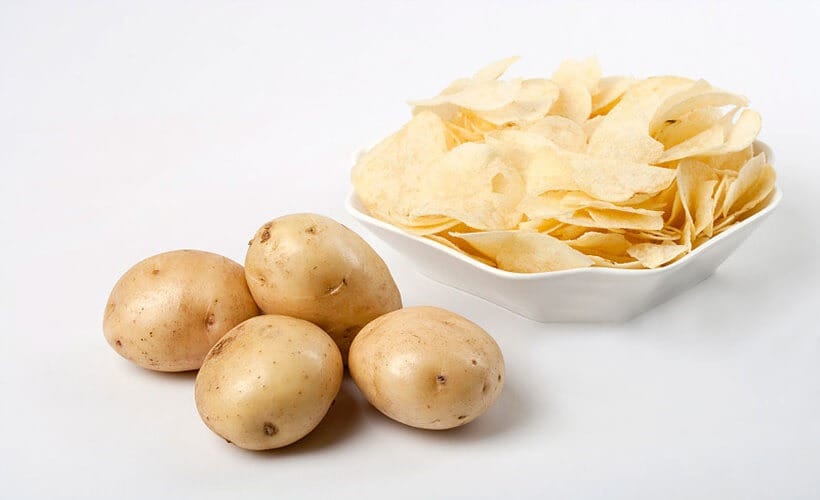
1. Potato Preparation: Choosing the Right Raw Material
To produce high-quality fried potato chips with lower oil content, potato selection is the first and most important step.
Ideal potatoes for chips production should have:
-
Uniform tuber size and neat appearance
-
Few bud eyes
-
High starch and dry matter content
-
High relative density
-
Low reducing sugar content
-
Low moisture content
These characteristics help increase yield, improve texture, and significantly reduce oil absorption during frying.
2. Potato Cutting: Slice Thickness Matters
The thickness of potato slices has a direct impact on oil content.
-
Oil content is inversely proportional to slice thickness
-
Slices that are too thin tend to over-fry and absorb more oil
In commercial production, potato slice thickness is generally not less than 1 mm. Using a precision potato cutting machine ensures uniform slices, stable frying results, and controlled oil absorption.
3. Potato Chips Blanching: Reducing Oil Uptake Before Frying
Blanching potato slices before frying is a critical step in industrial potato chips production.
Benefits of blanching include:
-
Preserving fresh color
-
Eliminating off-flavors
-
Retaining natural potato taste
-
Softening cell structure for moisture evaporation
-
Reducing oil absorption during frying
Blanching causes starch gelatinization on the chip surface, forming a protective layer that limits oil penetration. Using an electric potato blanching machine also stops enzyme activity, improving product stability.
4. Potato Chips Frying: Temperature and Time Control
Frying is the process of cooking and drying food through direct contact with hot oil.
During frying:
-
Water evaporates from the potato slices
-
Oil replaces the lost moisture
-
The outer surface absorbs oil first due to direct contact
Oil temperature and frying time are closely related to:
-
Potato dry matter content
-
Slice thickness
-
Degree of blanching
Best practice:
Experiments show that high frying temperature with a short frying time helps reduce oil uptake. However, the oil temperature should not exceed 200°C, as excessive heat accelerates oil degradation and shortens oil shelf life.
5. Potato Chips De-Oiling: Final Control of Oil Content
After frying, potato chips are at high temperature and pressure. When removed from the fryer, cooling begins, causing pressure inside the chip pores to decrease. As a result, surface oil is drawn into the internal structure of the chips.
A potato chips de-oiling machine plays a crucial role at this stage by:
-
Removing excess surface oil
-
Preventing oil re-absorption
-
Significantly lowering final oil content
-
Improving crispness and shelf life
This step ensures the finished potato chips are light, crispy, and less greasy, meeting modern health expectations.
