 Skip to content
Manual cutting can no longer keep pace with modern food production. This guide covers everything industrial buyers need to know — from core technology and materials to supplier selection and emerging trends.

Why Industrial Vegetable Slicers Matter More Than Ever
Manual cutting yields just 10–15 kg of processed vegetables per hour — with size inconsistencies of ±1–2 mm. For large-scale food producers, that’s unacceptable. Rising labor costs (up 8–10% annually) and the explosive growth of pre-packaged meal services have pushed demand for automated slicing to record highs.
| Key Metric | Insight |
|---|---|
| $130B Market | Massive Industry Demand in 2024 |
| 7.69% Annual Growth | Rapid Expansion Expected in 2025 |
| ±0.1mm Precision | Advanced AI Cutting Technology |
| 35% Smart Adoption | IoT-Integrated Machines by 2025 |
The prepared meal industry, e-commerce fresh food platforms, and central kitchen networks are the biggest growth drivers. For B2B buyers, selecting the right slicer is no longer about basic functionality — it’s a strategic decision that affects throughput, compliance, and profitability.
How Industrial Vegetable Slicers Work
Every high-performance slicer integrates three core stages: feeding, cutting, and discharge. The design of each stage determines how well the machine handles different produce types.
Rotary vs. Reciprocating Blade Systems
Rotary blade systems spin at 300–500 RPM and excel with dense root vegetables like carrots and potatoes, delivering uniform thickness with minimal fiber damage. Reciprocating systems use an oscillating blade better suited for leafy greens such as spinach and lettuce — reducing bruising and preserving freshness.
Materials, Construction & Food Safety Standards
Food safety isn’t optional — it’s a procurement requirement. Here’s what to verify before purchasing:
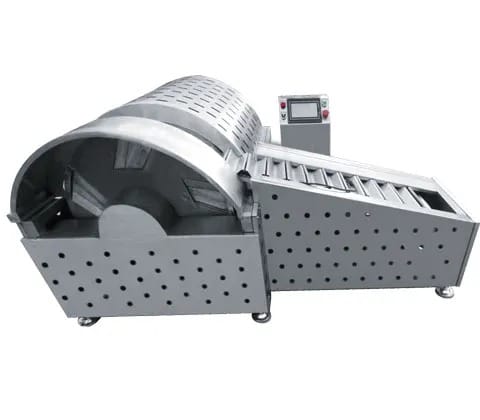
Frame material: SUS304 stainless steel is the industry standard — corrosion-resistant, easy to sanitize, and compliant with FDA and EU food-contact regulations. Conveyor belts must be food-grade non-toxic rubber. Blades should be hardened stainless steel (HRC 55–60 Rockwell), precision-stamped at 0.5 mm thickness to maximize edge retention and reduce maintenance frequency.
Poor blade balance is a hidden risk. If a manufacturer skips resonance testing, the result is motor-frame vibration — reducing blade life, cut quality, and operator safety. Always request vibration test documentation.
Key Performance Factors to Evaluate
Motor power
For operations processing over 100 kg/hour, a motor of 3 kW or higher is essential. Underpowered motors below 1.5 kW struggle with dense produce, causing inconsistent cuts and premature wear.
Weight distribution
Machines with inadequate base weight or poorly positioned components shake during operation — damaging both product quality and machine longevity. A reinforced frame with at least 3 mm steel thickness minimizes this risk.
Blade maintenance design
Quick-release blade assemblies are critical in 24/7 production environments. Self-sharpening mechanisms and blade wear sensors extend operational efficiency and reduce total cost of ownership.
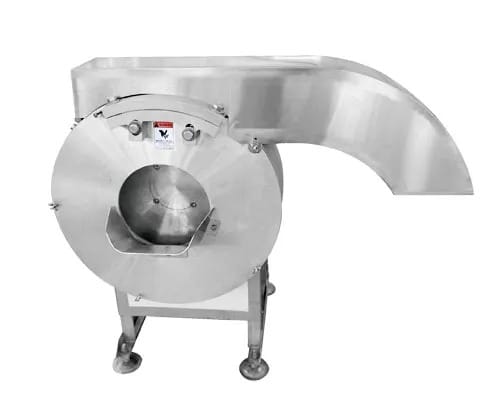
How to Evaluate a Vegetable Slicer Supplier
Price is just one factor. A thorough supplier evaluation should cover:
Certifications: ISO 22000, CE marking, and material safety data sheets (MSDS) for all food-contact parts. Customization: Can the supplier configure blade types, throughput capacity, and control systems to your workflow? After-sales support: Spare parts lead times under 72 hours for critical components (blades, motors) are a reasonable benchmark. On-site training and multilingual support matter for global operations. Track record: Ask for case studies from similar production environments and check customer retention rates.
Common Problems & How to Avoid Them
Excessive vibration — caused by low-quality steel or motor-resonance mismatches. Solution: require vibration test reports and specify minimum 3 mm frame thickness. Uneven slicing of irregular produce — look for adaptive feeding systems or AI vision adjustment. Jamming on soft vegetables (zucchini, cucumber) — adjustable pressure feeding mechanisms prevent deformation without sacrificing throughput. Difficult skewer removal on hard produce — modified partial-insertion skewer designs solve this. Large leftover cores — optimized core-reduction settings or secondary processing modules minimize waste.
Real-World Applications
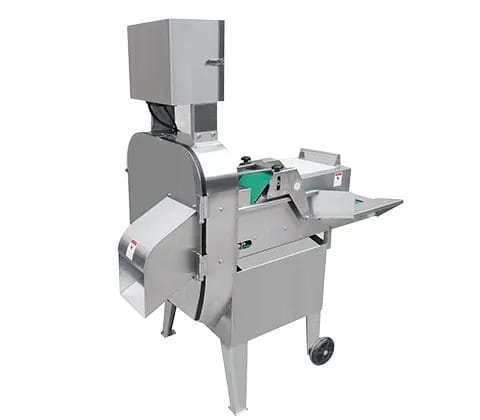
Central kitchens: High-speed slicers (80–120 kg/hour) reduce labor costs by up to 35% and cut prep time by 60% compared to manual methods. Prepared meal manufacturers: Precision-controlled slicers ensure portion consistency — directly impacting brand reputation and customer satisfaction. Frozen vegetable production: Specialized cold-resistant models maintain performance at -18°C. Canning facilities: Automated inline slicers have reduced reject rates from 8% to under 2% at leading plants.
Trends Shaping the Industry in 2026
IoT integration: Over 35% of industrial slicers are expected to feature IoT capabilities by 2026, enabling predictive maintenance and real-time performance monitoring — reducing unplanned downtime by up to 40%. Energy efficiency: Brushless DC motors and regenerative braking are cutting power consumption by 15–20% versus traditional models. Modular design: Easier upgrades and component replacement extend machine lifecycles and reduce environmental impact. Robotics & machine learning: Future systems will use collaborative robots for feeding and sorting, with ML algorithms that automatically adapt cutting parameters to new produce varieties.
Frequently Asked Questions
How long does an industrial vegetable slicer typically last?
With SUS304 stainless steel construction, hardened blades, and regular maintenance, a well-built slicer can operate reliably for 7–10 years. Regular blade sharpening and lubrication are the most important upkeep tasks.
Can one machine handle multiple vegetable types?
Yes. Modular slicers with interchangeable blade assemblies can process root vegetables, leafy greens, and soft produce. Look for models with quick-change systems under 5 minutes per changeover.
What safety certifications should I require?
At minimum: CE marking, ISO 22000 compliance, blade guards, emergency stop buttons, and interlock systems that prevent operation when protective covers are open.
How do IoT-enabled slicers reduce downtime?
By collecting real-time data on blade wear, throughput, and energy usage, IoT systems can alert operators before components fail — reducing unplanned stoppages by up to 40%.
How can I reduce vegetable core waste?
Select slicers with adjustable core-size settings, or add secondary processing attachments that convert leftover cores into shredded or diced products for use in soups and sauces.
Article summary
Industrial vegetable slicers have become essential infrastructure for food processors, central kitchens, and prepared meal manufacturers. With the Chinese market alone valued at 130 billion RMB and growing at nearly 8% annually, the technology is evolving fast — from AI-powered precision cutting and IoT-enabled predictive maintenance to energy-efficient motors and modular designs. For B2B buyers, the key decision factors are motor power, blade quality, food safety certifications, and after-sales support. The best slicers combine SUS304 stainless steel construction, hardened blades rated HRC 55–60, and adaptive feeding systems that handle everything from leafy greens to frozen root vegetables. As labor costs rise and production demands grow, investing in the right automated slicer is one of the highest-ROI decisions a food operation can make.
