 Skip to content
Manual basket cleaning takes up to 60 minutes per unit and still fails regulatory audits. This guide shows industrial buyers exactly what to look for — pressure specs, machine types, certifications, and how to calculate real ROI.
Why Automated Basket Cleaning Has Become Non-Negotiable
Processing baskets accumulate stubborn residues — food particles, grease, baked-on deposits, chemical compounds — that manual washing and soak tanks simply cannot remove reliably. The consequences go beyond hygiene: inconsistent sanitization leads to cross-contamination, failed regulatory inspections, and production downtime.
| Key Metric | Insight |
|---|---|
| $52.3B Market | Global Industrial Cleaning Equipment Market Size (2023) |
| $78.6B Forecast | Projected Market Value by 2030 |
| 70% Time Reduction | Faster Cleaning Compared to Manual Methods |
| 40% Less Chemicals | Reduced Usage with Temperature-Assisted Systems |
The global market for high-pressure cleaning equipment is on track to reach $78.6 billion by 2030, with basket-specific systems contributing 6.8% of that growth. For B2B buyers, the decision to automate is increasingly driven by rising labor costs, tighter food safety regulations (FDA 21 CFR Part 117, EU 852/2004, GMP), and the demand for verifiable, auditable sanitation records.
How High-Pressure Basket Cleaning Machines Work
These machines integrate fluid dynamics, precision engineering, and automated controls to deliver high-velocity water jets that remove contaminants without damaging equipment. Water is pressurized to 50–200 bar (725–2,900 psi) and forced through precision nozzles — creating jets with enough kinetic energy to dislodge even the most stubborn residues.
Unlike traditional methods that depend on prolonged soaking or aggressive detergents, modern machines use mechanical force combined with temperature control (40–80°C) — increasing cleaning efficacy while reducing chemical consumption by up to 40%.
Three Machine Types: Which One Fits Your Operation?
1. Rotary basket cleaning machines
The basket rotates at 10–30 RPM while fixed spray arms deliver 360° coverage. Adjustable nozzle angles (0–45°) reach corners, mesh openings, and handles. Best for batch processing of 5–20 baskets per hour. Ideal for food processors, dairies, and mid-scale manufacturing.
2. Tunnel-type continuous cleaning systems
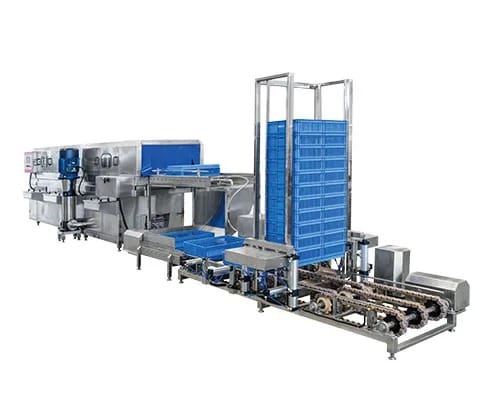
Baskets move through pre-rinse, main wash, and rinse zones on a conveyor. Throughput: 20–100 baskets per hour. Best for high-volume operations — large food plants, pharmaceutical manufacturers, and automotive suppliers with continuous production lines.
3. Ultrasonic-assisted high-pressure cleaners
Combines high-pressure jets with 20–40 kHz ultrasonic waves to break down adhesive residues at the molecular level — including baked-on food, chemical deposits, and metal shavings. Best for pharmaceutical, automotive, and precision manufacturing where residue-free surfaces are mission-critical.
Pressure & Temperature Selection Guide
Choosing the wrong pressure damages baskets; choosing too little leaves residues behind. Use this reference:
| Residue Type | Pressure Range | Temperature | Typical Application |
|---|---|---|---|
| Light food residues (flour, produce) | 50–100 bar | 40–60°C | Bakery, fresh produce |
| Grease and oil | 100–150 bar | 60–70°C | Meat processing, dairy |
| Baked-on or chemical residues | 150–200 bar | 70–80°C | Pharmaceutical, automotive |
Materials, Construction & Compliance Standards
Food-grade and pharma-grade machines demand a specific material specification. Key components to verify before purchase:
Spray arms and nozzles: 316L stainless steel with precision-drilled orifices (0.3–1.5 mm) and self-cleaning anti-clog channels. Pump system: Triplex plunger pumps (5.5–37 kW) with ceramic pistons — delivering consistent pressure within ±2 bar and resisting corrosion from detergents and hot water. Frame and wetted surfaces: Robotic-welded 316L stainless steel with no crevices or harborage points. Manufacturing tolerance: CNC-machined pump components to ±0.01 mm. All food-grade models should comply with USDA FSIS, EU 10/2011, ISO 9001, CE, and where applicable, GMP standards.
Industry Applications & Real-World Results
📊 Industry Applications & Results
| Industry | Key Results |
|---|---|
| Food Processing | Cleaning time reduced from 45 min to 8 min per batch; cross-contamination incidents completely eliminated |
| Pharmaceutical | Achieved 99.9% residue removal; consistently passed FDA audits with GMP tunnel system |
| Bakery & Confectionery | 65% reduction in water usage; annual savings of $12,000 per facility with recycling rotary model |
| Automotive | 25% improvement in component quality; rework caused by residue contamination eliminated with 150-bar ultrasonic system |
| Dairy Processing | Bacterial contamination risk eliminated; product shelf life extended by 3 days with 60–80°C temperature control |
How to Evaluate a Supplier
Certifications: Require ISO 9001, CE, and application-specific compliance (FDA, GMP, EU 852/2004). Request material safety data sheets for all food-contact components. Customization: Can the supplier configure pressure range, basket size compatibility, heating type (electric, steam, gas), and detergent dosing to your exact process? After-sales support: Spare parts lead times under 72 hours for pumps, nozzles, and heating elements. On-site installation and HACCP-compliant operator training should be standard. Warranty: Minimum 1-year parts and labor; extended coverage for pump systems is a positive indicator of product confidence. Global buyers: Verify local power standard compatibility (110V/230V) and availability of multilingual control panels.
Common Problems & How to Prevent Them
Nozzle clogging — causes uneven spray and forces 15–20% of baskets to be re-cleaned. Prevention: specify inline filtration (20–50 μm) and self-cleaning nozzle design. Incomplete cleaning in corners and mesh gaps — mitigated by 360° rotating spray arms and targeted jet nozzles. High water and energy costs — water recycling systems with multi-stage filtration and UV disinfection cut water usage by 60% and energy by 30%. Long changeover times for different basket sizes — modular quick-adjust holders reduce transition from 20 minutes to under 5. Premature corrosion and wear — specify 316L stainless steel and ceramic pump components; these extend service life by up to 50%.
2026 Trends: IoT, Sustainability & AI Optimization
IoT and Industry 4.0: By 2030, over 45% of industrial basket cleaning machines will feature IoT connectivity (up from 18% in 2024). Real-time monitoring of pressure, temperature, and cycle data enables predictive maintenance — reducing unplanned downtime before it happens. Sustainability: Next-generation machines cut water usage by 70%, energy by 30%, and chemical dependency by 40% through reverse osmosis recycling, heat recovery units, and enzyme-compatible dosing systems. AI-powered cleaning optimization: Future systems will use sensors to identify residue type, basket material, and size — automatically adjusting pressure, temperature, and cycle time for optimal results with minimum resource consumption. Collaborative robots (cobots): Automated basket loading and unloading reduces operator exposure to high-pressure water and chemicals, improving both throughput and workplace safety.
Frequently Asked Questions
How long does an industrial basket cleaning machine typically last?
With regular maintenance — nozzle cleaning, pump servicing, and filter changes — well-built machines operate reliably for 8–12 years. Models built with 316L stainless steel and modular components can reach 15+ years.
Can these machines handle different basket sizes?
Yes. Modular machines with quick-adjust basket holders and interchangeable spray arm attachments accommodate a range of basket sizes. Rotary models typically handle 300–800 mm diameter baskets; tunnel systems can process baskets up to 1,000 mm in length.
What safety features are required for commercial use?
Non-negotiable features include door interlock systems, emergency stop buttons, pressure relief valves, thermal overload protection, and splash guards. High-temperature models require heat-resistant handles and temperature alarms. CE (EU) and OSHA (US) compliance is mandatory.
What are the real cost savings vs. manual cleaning?
For a facility cleaning 50 baskets daily, automation typically delivers annual savings of $15,000–$30,000 through reduced labor (70–80%), lower water consumption (50–70%), and reduced detergent costs (30–40%) — plus avoided costs from compliance failures and product recalls.
Do these machines work for non-food applications?
Yes. Tunnel systems and ultrasonic-assisted models are widely used in automotive manufacturing (removing oil and metal shavings), pharmaceutical production (sterile processing baskets), and electronics (component cleaning). Pressure and material specifications differ by application.
Article summary
High-pressure water spray basket cleaning machines have become essential infrastructure across food processing, pharmaceutical manufacturing, dairy, bakery, and industrial production. With the global cleaning equipment market heading toward $78.6 billion by 2030, the technology is advancing rapidly — from rotary and tunnel-type systems to ultrasonic-assisted cleaners and IoT-enabled predictive maintenance platforms. For B2B buyers, the key decision factors are pressure range (50–200 bar), temperature control (40–80°C), machine type (rotary vs. tunnel), material compliance (316L stainless steel, CE/FDA certified), and after-sales support quality. Properly specified machines reduce cleaning time by 70%, cut water usage by up to 60%, and eliminate the cross-contamination risks that manual methods cannot reliably prevent. As regulations tighten and sustainability targets rise, investing in automated basket cleaning is one of the highest-ROI equipment decisions a production facility can make.
