 Skip to content
2026 Investment GuideEverything you need to know before investing — from startup CapEx and equipment pricing to monthly OpEx, ROI timelines, and how to choose the right production scale.
Quick Answer
In 2026, a French fries manufacturing plant costs between $10,000 and $5 million+, depending on production scale and automation level. A mid-sized automated plant producing 500 kg/h typically requires an initial investment of $55,000–$95,000. Small lines pay back in 1–2 years; large industrial facilities in 3–8 years.
📋 Table of Contents
- Why Invest in French Fries Manufacturing in 2026?
- Total Startup Cost: What to Expect
- Core CapEx Breakdown (Medium-Scale Example)
- Equipment Cost by Production Scale
- Key Equipment Component Prices
- Monthly Operating Expenses (OpEx)
- Return on Investment (ROI) Analysis
- Key Factors That Affect Plant Cost
- Frequently Asked Questions
- Conclusion & Next Steps
1. Why Invest in French Fries Manufacturing in 2026?
The global French fries market is one of the most resilient and rapidly expanding segments of the food processing industry. Before diving into plant costs, it’s worth understanding the commercial opportunity that makes this investment so compelling.
Global Market Size (2026)
CAGR through 2034
Projected Market by 2034
Frozen Fries Market Share
According to the latest industry data, the global French fries market is valued at approximately $18.9 billion in 2026 and is projected to grow to nearly $30 billion by 2034, driven by the expansion of quick-service restaurants (QSRs), the boom in food delivery platforms, and rising demand for frozen convenience foods in emerging markets across Asia, Latin America, and the Middle East.
The frozen segment is especially dominant — accounting for over 82% of global market share in 2026 — while the food service segment represents approximately 60% of all end-use demand. For producers and investors, this means a large, growing, and structurally reliable customer base.
Innovations such as air fryer-compatible frozen fries, crinkle-cut specialty products, and organic variants are opening new premium pricing lanes. Brands that invest in production quality and flexibility today are best positioned to capture this value.
2. Total Startup Cost: What to Expect
The total cost to establish a French fries manufacturing plant varies enormously based on three primary variables: target production capacity, degree of automation, and geographic location. Here is a clear overview of what each investment tier looks like in 2026:
Small / Pilot
50–300 kg/h
Semi-automatic systems. Ideal for startups, regional suppliers, or product testing. Fast payback potential.
Medium Commercial
1–5 tons/h
Fully automated lines including packaging. Suitable for regional and national distribution operations.
Large Industrial
5–50+ tons/h
Highly integrated plants with IQF tunnels and SCADA control. Built for export-scale production.
These figures represent equipment-only costs for smaller scales, or total plant investment for larger operations. Always factor in factory construction, utilities, labor, raw materials, and working capital — all detailed in the sections below.
3. Core CapEx Breakdown — Medium-Scale Example (500 kg/h)
To give you a real-world benchmark, here is a detailed CapEx breakdown for a fully automated production line at approximately 500 kg/h capacity — the most common entry point for serious commercial operators. Total estimated initial investment: $55,000 – $95,000
| Investment Item | Estimated Cost (USD) | Notes |
|---|---|---|
| 🏭 Core Production Equipment | $35,000 – $60,000 | Washing, peeling, cutting, blanching, frying systems |
| 🔧 Factory Construction & Utilities | $10,000 – $20,000 | Power supply, water, ventilation, and facility upgrades |
| 👷 Labor & Training | $5,000 – $8,000 | Initial hiring, technical training, safety education |
| 🥔 Initial Raw Materials | $3,000 – $5,000 | Potatoes, cooking oil, seasonings, packaging materials |
| 📦 Marketing & Distribution | $2,000 – $5,000 | Brand promotion, packaging design, logistics setup |
| Total Estimated Investment | $55,000 – $95,000 | For a 500 kg/h automated line |
Many first-time investors focus exclusively on equipment and overlook utility upgrades, regulatory compliance, food safety certification, and initial marketing spend. These “soft costs” can add 15–25% to your total startup budget if not planned in advance.
4. French Fries Equipment Cost by Production Scale
Production equipment is the single largest component of your capital investment, typically representing 55–70% of total CapEx. Understanding price ranges by scale helps you avoid both under-investing in capacity and over-specifying for your market.
| Production Scale | Capacity | Equipment Cost Range | Automation Level | Best For |
|---|---|---|---|---|
| Small / Pilot | 100–300 kg/h | $10,000 – $60,000 | Semi-automatic | Startups, local suppliers |
| Medium Commercial | 1–5 tons/h | $60,000 – $300,000 | Fully automatic | Regional/national brands |
| Large Industrial | 5–50+ tons/h | $300,000 – $5,000,000+ | Fully integrated + SCADA | Export-scale operations |
Semi-Automatic vs. Fully Automatic: Which Is Right for You?
| Factor | Semi-Automatic | Fully Automatic |
|---|---|---|
| Initial Investment | Lower | Higher |
| Labor Required | More workers needed | Minimal — PLC-controlled |
| Output Consistency | Good | Excellent — precise and uniform |
| Long-Term Labor Cost | High | Low — recovers premium quickly |
| Scalability | Moderate | High — easier to expand capacity |
| Best For | Budgets under $60,000 | Serious commercial operations |
5. Key Equipment Component Costs
If you are purchasing equipment individually — to upgrade an existing line or build a custom configuration — the following reference prices will help you budget accurately. These figures reflect 2026 market pricing from established global manufacturers.
| Equipment | Price Range (USD) | Notes |
|---|---|---|
| 🫧 Washing & Grading Machine | $3,000 – $50,000 | Varies by capacity and drum type |
| 🟤 Peeling Machine (Abrasive or Steam) | $5,000 – $80,000 | Steam peelers offer lower peeling loss |
| 🔥 Continuous Fryer | $20,000 – $250,000 | Primary cost driver — biggest quality impact |
| ❄️ IQF Freezing System | $50,000 – $700,000+ | Essential for frozen fries; tunnel vs. spiral type |
| 📦 Fully Automatic Packaging Machine | $10,000 – $250,000+ | Multi-head weigher + vertical form-fill-seal |
| ✂️ Cutting Machine | $3,000 – $30,000 | Strip width 3mm–12mm configurable |
| ♨️ Blanching Machine | $5,000 – $40,000 | Preserves color and texture pre-fry |
The continuous fryer and IQF freezing system most directly determine product quality and shelf life. If your budget is tight, prioritize quality here before cutting costs elsewhere. A poor fryer leads to inconsistent color, texture, and oil absorption — all of which affect customer retention.
6. Monthly Operating Expenses (OpEx)
Capital investment gets you started — but operating expenses (OpEx) determine your long-term profitability. For a medium-sized plant generating approximately $200,000 in monthly revenue, estimated monthly operating costs may exceed $140,000.
| Cost Category | Estimated Monthly Cost | Notes |
|---|---|---|
| 🥔 Raw Materials (Potatoes & Oil) | 15%–20% of monthly revenue | Largest single variable cost |
| 🏢 Facility Rent | $15,000 – $18,000 | Varies significantly by region |
| 👩🏭 Labor Costs | $60,000+ (medium-large plants) | Highly dependent on automation level |
| 🚚 Distribution & Logistics | 30%–80% of sales revenue | Highest for early-stage brands |
| ⚡ Energy (Electricity, Gas) | Varies by equipment | Fryer and freezer are main consumers |
| 🔩 Maintenance & Spare Parts | 1%–3% of equipment value/year | Higher for older or low-quality lines |
A 20% spike in potato prices can cut your profit margins by half. Consider establishing supply agreements with multiple potato farmers, or evaluate proximity to agricultural regions to reduce input cost volatility.
7. Return on Investment (ROI) Analysis
ROI in French fries manufacturing is primarily driven by three levers: capacity utilization, raw material cost management, and energy efficiency.
| Scale | CapEx Range | Payback Period | Key ROI Drivers |
|---|---|---|---|
| Small (~1 t/h) | $50,000 – $80,000 | 1–2 years | Local markets, fresh-cut or frozen fries |
| Medium (~5 t/h) | $200,000 – $400,000 | 3–5 years | Energy efficiency, raw material cost control |
| Large (~20+ t/h) | $2,000,000+ | 5–8 years | Economies of scale, export markets |
Variables That Can Shorten — or Extend — Your ROI
- A 10% drop in capacity utilization can extend payback by 1–2 years
- Energy-efficient fryers and IQF systems meaningfully reduce monthly OpEx
- Premium product positioning (specialty cuts, seasoned fries, organic) can increase revenue per kg by 30–80%
- Direct distribution channels can reduce distribution cost from 80% down to 30% of revenue
- Potato price volatility is the most common unexpected ROI disruptor
8. Key Factors That Affect French Fries Plant Cost
No two plant budgets are identical. The following factors have the greatest influence on your final investment figure:
1. Production Capacity
This is the most direct cost driver. Equipment specifications, factory footprint, and utility requirements all scale with output. Larger systems often achieve better cost-per-unit economics through integrated automation.
2. Automation Level
Semi-automatic lines are cheaper upfront but carry higher long-term labor costs. Fully automatic lines with PLC control systems require greater initial investment but deliver significantly better labor efficiency and product consistency — making them the preferred choice for any operation targeting national or export markets.
3. Product Type: Fresh vs. Frozen
Fresh-cut French fries require a simpler equipment configuration (no IQF freezing system). Frozen French fries production adds the IQF tunnel — the most expensive individual equipment item — but opens access to higher-margin export markets, longer shelf life, and QSR supply contracts.
4. Factory Construction & Utilities
Factory area requirements scale significantly with production capacity: small plants (200–500 kg/h) typically need 500–1,000 m²; medium plants (1–2 t/h) need 1,500–3,000 m²; large plants (5+ t/h) require over 5,000 m².
5. Geographic Location
Labor costs, energy tariffs, local building codes, and proximity to potato-growing regions all significantly influence both capital and operating budgets. Plants located near raw material sources benefit from reduced transportation costs and fresher potato quality.
6. Equipment Supplier & After-Sales Support
Price is only one dimension when selecting an equipment partner. After-sales service quality, availability of spare parts, and warranty terms can dramatically affect your long-term cost of ownership. Always request references and evaluate technical service responsiveness before committing.
Start with a small-to-medium operation and validate your market before scaling. Many successful large-scale plants today began as regional pilot lines, allowing operators to refine their product, establish distribution, and build working capital before committing to major CapEx expansion.
9. Frequently Asked Questions
Q: How much does a French fries manufacturing plant cost in 2026?
In 2026, total investment ranges from $10,000 for a small pilot line to over $5 million for a fully automated large-scale industrial facility. The most common entry point for commercial operations — a medium-scale automated line at 500 kg/h — requires approximately $55,000–$95,000 in initial investment.
Q: What equipment is needed for a French fries production line?
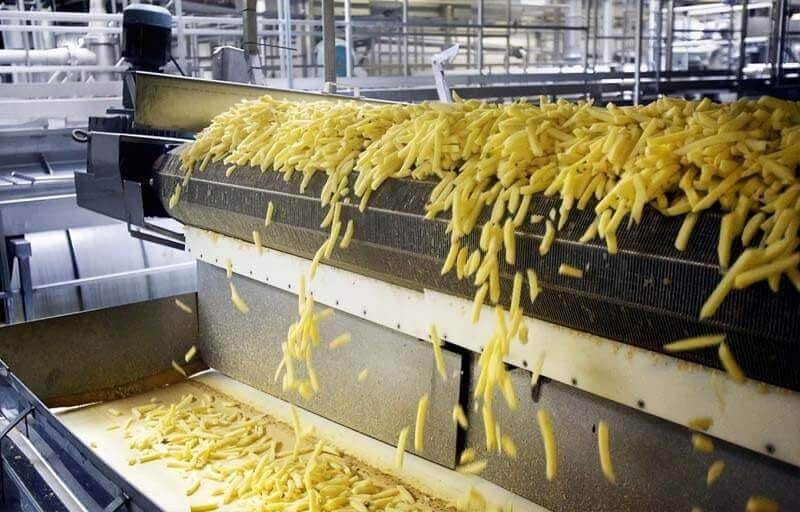
A complete French fries production line includes: washing and grading machine, peeling machine (abrasive or steam), cutting machine, blanching machine, dewatering unit, continuous fryer, deoiling conveyor, IQF freezing tunnel (for frozen fries), seasoning drum, and automatic packaging machine.
Q: How long does it take to get a return on investment?
Small production lines typically achieve payback within 1–2 years. Medium lines require 3–5 years. Large industrial plants typically take 5–8 years to recover their investment, though they benefit from greater long-term profitability through economies of scale and export market access.
Q: Is a French fries plant profitable?
Yes — when properly planned and efficiently operated. Gross profit per ton of processed potatoes can reach $300–$500, and the global market continues to grow at approximately 5–6% annually. Profitability depends heavily on raw material sourcing, energy costs, capacity utilization, and distribution strategy.
Q: What is the difference between a fresh and frozen French fries plant?
A fresh-cut plant does not require an IQF freezing system, making it significantly cheaper to set up. However, frozen French fries plants access a larger global market, offer longer shelf life, command premium pricing, and enable better production planning. The frozen segment accounts for over 82% of the global market in 2026.
Q: What are the main operating costs of a French fries factory?
The main operating costs are: raw materials — potatoes and frying oil (60–70% of OpEx); facility rent ($15,000–$18,000/month); labor (potentially over $60,000/month); energy costs for the fryer and freezer; and distribution and logistics (30–80% of sales revenue for early-stage brands).
Q: How big does my factory need to be?
A small plant (200–500 kg/h) needs roughly 500–1,000 m². A medium plant (1–2 t/h) requires 1,500–3,000 m². A large plant (5+ t/h) typically needs over 5,000 m². Factory location near potato-growing regions is strongly recommended to reduce raw material transport costs.
10. Conclusion: Planning Your French Fries Plant Investment
Setting up a French fries manufacturing plant in 2026 is one of the more compelling opportunities in the global food processing sector. The market fundamentals are strong — a $18.9 billion industry growing at nearly 6% annually, driven by QSR expansion, rising frozen food demand, and food delivery growth in emerging markets.
The key to a successful investment lies in matching your production scale to your realistic market capacity, choosing equipment that balances automation with your budget, and building an operating model that minimizes raw material waste and energy consumption.
✅ Your Pre-Investment Checklist
- Define your target production capacity based on confirmed or projected demand
- Decide on product type: fresh-cut, par-fried, or IQF frozen French fries
- Choose automation level: semi-automatic (lower CapEx) or fully automatic (lower long-term OpEx)
- Identify factory location with access to potato supply and key distribution routes
- Build a full CapEx model: equipment + construction + utilities + training + working capital
- Project monthly OpEx: raw materials, rent, labor, energy, maintenance, and distribution
- Calculate ROI and payback period under both optimistic and conservative scenarios
- Shortlist equipment suppliers and verify after-sales service quality and spare parts availability
- Obtain all necessary food safety certifications and local regulatory approvals
- Consider a phased capacity rollout: validate the market at small scale before committing to full plant CapEx
Build Your French Fries Plant with HANHUI
Choosing the right equipment partner is as important as your budget. HANHUI specializes in complete French fries processing solutions — from small pilot lines to large-scale fully automated industrial plants.
- Customized production line design based on your target capacity
- High-efficiency washing, steam peeling, cutting, blanching & frying systems
- Energy-saving continuous fryers with advanced oil filtration
- IQF freezing tunnels for premium frozen French fries production
- Fully automatic packaging integration
- Turnkey project support: plant layout, installation & commissioning
- Global technical service and after-sales assistance
